
November 7, 2026 · By Dhurka Manchukan, Software Engineer · Product · 4 min read
Building a travel toolkit that works without an account
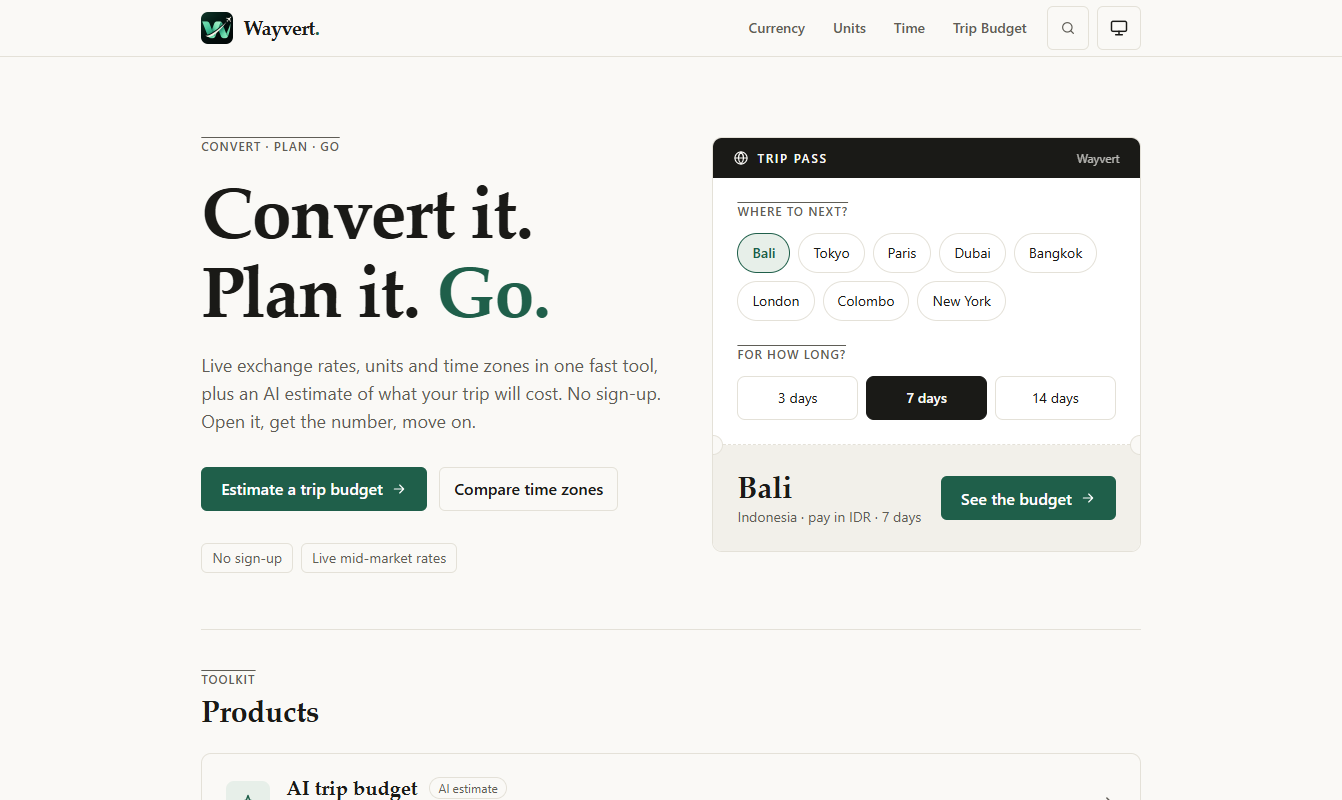
Wayvert started from the small checks that surround every trip. Before a holiday there is always a moment of converting a price, working out whether a call will land at a sensible hour, or wondering whether a destination is affordable. Each answer lives on a different website, and most of them want an account or bury the number under clutter. The goal was one quick stop that answers all of it and gets out of the way.
Keep the conversions on the device
Unit conversion and time zones need no server at all. The browser already knows the world's time-zone database through the Intl API, so daylight saving is handled for free, and unit conversion is plain arithmetic. Only exchange rates need data from outside, so the server fetches them from a chain of free sources and falls back to the next one if a source fails. If every source fails, the tool says so instead of showing an invented number.
Time zones are harder than they look
A meeting finder sounds easy until a day has 23 or 25 hours because clocks change. Wayvert stores the chosen moment as an absolute instant and does day maths on wall-clock time, so the slider never silently reinterprets a time when you change the reference city. Each half-hour slot is scored by how many cities fall outside working hours, so the suggested time is the fairest one, not just the first one that fits.
Use AI where it helps, and fence it in
A trip budget is a good fit for a language model because the answer is a judgement based on a lot of scattered knowledge. It is also a place where a model can go wrong, so the design is defensive. The destination must come from a curated list, free text never reaches the prompt, the response must match a strict schema, and results are cached, rate limited and capped per day to control cost.
The caching and limits matter as much as the prompt. A trip budget for the same destination and style does not need a fresh model call every time, so repeat requests are served from a cache, which is faster for the visitor and cheaper to run. Rate limits and a daily cap stop a burst of traffic from turning into a surprise bill. These controls are invisible when things go well, which is exactly why they are easy to leave out and worth building first.
Why there is no account
An account would add a sign-up step to tools that take a few seconds to use, and it would mean storing data the product does not need. Preferences such as a home currency are remembered in the visitor's own browser instead. The only information that leaves the device for a trip budget is the destination and the travel style the visitor picked from fixed lists, and that is stated plainly on the page and in the privacy policy.
Be honest about uncertainty
Every budget is labelled an estimate, shown as per-person daily costs by category, and leaves flights out. If the AI is unavailable the tool falls back to a clearly marked regional average and never caches it. Telling visitors what a number is, and what it is not, matters more than making it look precise. The same rule applies to money: Wayvert shows where an exchange rate came from and how fresh it is, because a rate without a source is just a number.
Paying for it honestly
A free tool still has costs. Wayvert may show advertising and contains affiliate links for things like eSIMs and bookings. Affiliate links are labelled as sponsored and sit beside results rather than inside them, so they never change a calculation. Disclosing this clearly is both the right thing to do and the only way to keep the trust that a tool people rely on depends on.
Testing the awkward cases
- A conversion on a day when the clocks change, in one city but not in another.
- A meeting window that crosses midnight in one city and not another.
- Exchange-rate sources that are slow, wrong or simply down.
- A destination name that is not on the curated list, which must be rejected rather than guessed.
- Very large and very small amounts, and currencies with no decimal places.
Each of these has caused a bug at some point in many tools, which is why they are written down as test cases rather than left to chance. For a practical way to use the output, see How to estimate a trip budget before you book.
What I would tell someone building something similar
- Do as much as possible in the browser, and send the server only what it truly needs.
- Constrain AI input and output, and always have a labelled fallback.
- Treat money and time as hard problems and test the awkward cases, such as daylight-saving days.
- Say plainly what is an estimate, what is sponsored and what is stored.
Wayvert is free, needs no account and keeps your conversions on your device. It sits alongside QRinst and Faviqo as part of the same goal: practical software that stays simple.
Written by
Dhurka Manchukan
Software Engineer · Sri Lanka
Dhurka Manchukan is a software engineer based in Sri Lanka and the person behind MDXTORA. Dhurka designs, builds and runs QRinst, Faviqo and Wayvert, and writes the articles in the Journal from what comes up while building them.
About the author →Keep reading
- GuidesHow to estimate a trip budget before you bookA practical way to estimate what a trip will cost: the four daily categories, how to handle flights and currency, and how much buffer to add.
- ProductWhy I built a favicon generator that never uploads your logoNotes on building Faviqo — a browser-only favicon and app-icon toolkit — and the decisions behind keeping it private and server-free.
- ProductStatic vs dynamic QR codes: which should you use?A clear comparison of static and dynamic QR codes, with guidance on when each makes sense for menus, print, events and campaigns.